Introduction
Domestic violence is a multicausal social problem that significantly impairs comprehensive development, physical and psychosocial well-being, and mental health. This phenomenon encompasses manifestations such as child maltreatment, intimate partner violence, and the sexual abuse of children and adolescents (Burghart & Backhaus, 2024; Yu et al., 2022). Consequently, international organisations encourage the investigation of domestic violence, as it represents a major public health challenge given its long-term effects on the mental health, socio-emotional development, and quality of life of affected individuals (UNICEF, 2020; World Health Organization, 2022).
Scientific evidence highlights that violence within the family is not confined to the individual behaviour of a family member; rather, it constitutes a phenomenon shaped by social, cultural, and structural factors (World Health Organization, 2021, 2025). In many contexts, certain violent practices are perceived as legitimate forms of discipline or control, sustained by shared belief systems and hierarchical power relations within the household (Bourdieu, 2000). From this perspective, beliefs do not operate as isolated opinions but develop into paradigms that normalise violence. This process involves systems of thought centred on male dominance over women and children, or practices that become entrenched as customary disciplinary methods (Herranz Velázquez, 2025).
Several studies indicate that social beliefs regarding physical punishment, gender roles, and family privacy contribute to the normalisation of violent practices in the home (Bott et al., 2022; Heilmann et al., 2021). In some contexts, corporal punishment continues to be viewed as an acceptable disciplinary strategy, even though empirical evidence links it to adverse outcomes in the socio-emotional development and mental health of children and adolescents (Gershoff et al., 2018). Regarding intimate partner violence, the literature highlights the influence of cultural norms tied to gender inequality, male authority, and the notion that couple conflicts should remain private; such beliefs obscure violent behaviour and impede help-seeking efforts among victims (Illescas Zhicay et al., 2018). Similarly, in cases of child sexual abuse, persistent misconceptions attribute blame to victims, their families, or situational factors, thereby minimising the severity of the abuse and reinforcing dynamics of silence. Empirical evidence suggests that victims frequently experience guilt, apprehension, or fear of interpersonal and familial repercussions because prevailing cultural norms grant little credibility to children and adolescents. This disbelief forms a substantial barrier to disclosure, fostering a culture of silence around these experiences (Abdul Latiff et al., 2024; Alaggia & Collin-Vézina, 2020; McPherson et al., 2025).
The relationship between violence and psychological development has been extensively documented. Early exposure to family violence is associated with emotion regulation difficulties, attachment disruptions, and heightened stress sensitivity, all of which elevate the risk of repeating violent patterns later in life (Alaswad et al., 2026; Teicher et al., 2016). Furthermore, through intergenerational transmission, experiences of maltreatment or neglect often shape relational models, authority dynamics, and caregiving patterns in adulthood (Brown et al., 2023; Ying et al., 2025).
In Latin America, domestic violence is bound to multifaceted social and cultural factors, including gender inequalities, socioeconomic conditions, and normative expectations governing family interactions (Bott et al., 2019; Moreno Fernández et al., 2024). In Ecuador, recent research demonstrates that domestic violence remains a critical issue across diverse social groups and family structures, profoundly affecting mental health, community coexistence, and the exercise of fundamental rights (Aguirre-Burneo & Jaramillo Castillo, 2022; Caguana-Lasluisa et al., 2024; Observatorio Social del Ecuador, 2018; Ramírez et al., 2017; Serrano-Flores et al., 2024).
Understanding the beliefs that legitimise or conceal domestic violence is therefore essential for designing effective prevention and psychoeducational strategies. Examining these beliefs helps identify the cultural underpinnings that maintain such behaviours, informing socially responsive interventions that encourage equitable, non-violent family relationships. Within this framework, the present study aimed to examine beliefs associated with the legitimisation and concealment of domestic violence and evaluate their relationship with sociodemographic variables in an adult sample.
Methods
The study used a quantitative approach with a cross-sectional correlational design. This design enabled the examination of associations between variables at a single point in time, providing empirical evidence on patterns of relationships within the target population without inferring causality. The sample comprised 95 participants aged 17 to 62 years. Participation was voluntary and anonymous; written informed consent ensured confidentiality in accordance with ethical standards for research involving human participants. Recorded sociodemographic variables included age, sex, marital status, socioeconomic status, and parental educational attainment. For comparative analyses, age was categorised into three groups based on sample distribution and the requirement for sufficient subgroup sizes.
Data collection involved a sociodemographic questionnaire covering personal and family characteristics, alongside the Beliefs About Family Relationships Scale (Escala de Creencias sobre las Relaciones Familiares; Araya, 2003). The scale contains 39 items across three subscales: child maltreatment (14 items), domestic violence (12 items), and child and adolescent sexual abuse (13 items). Responses were registered on a 5-point Likert scale ranging from 1 (strongly disagree) to 5 (strongly agree), with higher scores reflecting greater legitimisation or concealment of violence. Total and subscale scores were derived by summing the corresponding item scores. Item 13 was reverse-scored prior to analysis due to negative phrasing.
The instrument demonstrated adequate internal consistency across all dimensions (child maltreatment, α = .88; domestic violence, α = .88; child and adolescent sexual abuse, α = .81) and for the overall scale (α = .92). Statistical analyses were conducted using IBM SPSS Statistics (Version 29). Descriptive statistics were computed, and non-parametric tests were employed to evaluate differences across dimensions and demographic groups. The threshold for statistical significance was set at p < .05.
Results
The sample (N = 95) comprised 63.2% women and 36.8% men. Participants were predominantly single (75.8%) and aged 17 to 62 years, with the largest proportion falling within the young adult bracket (17–24 years; M = 21.45, SD = 3.12). In terms of socioeconomic background, most participants identified as middle class (69.5%). Regarding parental education, secondary education was the most prevalent qualification (31.6% for mothers, 27.4% for fathers), closely followed by undergraduate degree attainment (30.5% for mothers, 29.5% for fathers), reflecting marginally higher educational levels among mothers. Complete data were available for all 95 participants across all assessed variables.
| Category | f | % |
|---|---|---|
| Sex | ||
| Women | 60 | 63.2 |
| Men | 35 | 36.8 |
| Marital status | ||
| Single | 72 | 75.8 |
| Married | 14 | 14.7 |
| Divorced | 3 | 3.2 |
| Cohabiting | 6 | 6.3 |
| Age | ||
| 17–24 years | 60 | 63.2 |
| 25–34 years | 19 | 20.0 |
| 35–62 years | 16 | 16.8 |
| Socioeconomic status | ||
| Low | 1 | 1.1 |
| Lower-middle | 20 | 21.1 |
| Middle | 66 | 69.5 |
| Upper-middle | 8 | 8.4 |
| Father's educational level | ||
| No formal education | 3 | 3.2 |
| Basic education | 23 | 24.2 |
| Secondary education | 26 | 27.4 |
| Technological education | 8 | 8.4 |
| University / undergraduate degree | 28 | 29.5 |
| University / postgraduate degree | 7 | 7.4 |
| Mother's educational level | ||
| No formal education | 3 | 3.2 |
| Basic education | 19 | 20.0 |
| Secondary education | 30 | 31.6 |
| Technological education | 7 | 7.4 |
| University / undergraduate degree | 29 | 30.5 |
| University / postgraduate degree | 7 | 7.4 |
Note. f = frequency.
Descriptive statistics were computed for the total Beliefs About Family Relationships Scale and its subscales to examine distribution patterns and compare legitimisation levels across violence subtypes (Table 2). Across the total scale, scores averaged 95.01 (SD = 24.85, range: 43–191). Among the subscales, child maltreatment yielded the highest scores (M = 38.96, SD = 12.33), followed by child and adolescent sexual abuse (M = 30.64, SD = 9.38) and domestic violence (M = 25.41, SD = 9.16). A related-samples Friedman test indicated statistically significant differences across the three dimensions, χ2(2) = 90.75, p < .001, demonstrating that legitimisation of violence varied substantially by subtype.
| Dimensions | Minimum | Maximum | M | SD |
|---|---|---|---|---|
| Total beliefs about family relationships | 43 | 191 | 95.01 | 24.85 |
| Childhood maltreatment | 16 | 66 | 38.96 | 12.33 |
| Sexual abuse | 13 | 65 | 30.64 | 9.38 |
| Domestic violence | 12 | 60 | 25.41 | 9.16 |
Note. M = mean; SD = standard deviation.
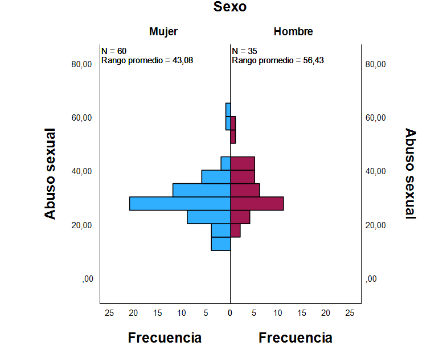
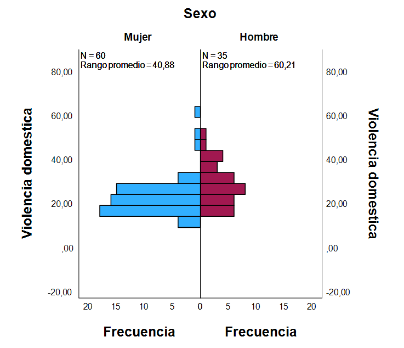
Analyses examining associations between the three dimensions and sociodemographic variables (age, marital status, socioeconomic status, and parental education) revealed no statistically significant differences in legitimisation levels. Conversely, significant differences emerged according to sex, with men obtaining systematically higher mean ranks than women across all three subscales, indicating a stronger overall tendency among men to legitimise domestic violence.
However, the analysis using the Mann-Whitney U test showed statistically significant differences only in the child maltreatment dimension (U = 1338, z = 2.22, p = .026, r = .23), in which men obtained higher mean ranks (R = 56.23) compared to women (R = 43.20; Figure 1).
Scores obtained on the dimensions of the Family Relationship Beliefs Scale by sex
 ```
```
 ```
```
Discussion
The present findings indicate that among the various forms of domestic violence, child maltreatment is the most widely legitimised, representing a known risk factor for subsequent mental health difficulties in adulthood (Cuartas, 2021; De Ruiter et al., 2022; Gershoff et al., 2025). Child maltreatment yielded the highest endorsement in this sample, corroborating previous evidence that physical punishment continues to be viewed as an acceptable disciplinary method in various settings (Gershoff et al., 2018; Lansford et al., 2014). Culturally, these results suggest the persistence of normative frameworks that equate parental authority with control and coercion. Rather than being recognised as violent behaviour, physical punishment is often interpreted as a legitimate corrective tool within child-rearing practices. This perspective reflects deeply ingrained beliefs regarding parental authority and the formative utility of punishment for behavioural regulation, thereby perpetuating its normalisation in everyday family dynamics (Global Partnership to End Violence Against Children, 2021; Richards et al., 2021).
From a sociocultural standpoint, such beliefs stem from traditional models of parental authority and the intergenerational transmission of coercive disciplinary practices. Social expectations concerning authority, obedience, and control shape the interpretation of specific behaviours within the family, facilitating the legitimisation of violence when framed as essential to child discipline (Heilmann et al., 2021; Ying et al., 2025). These representations foster the justification of coercive acts, particularly when linked to adult authority and the socialisation process. Consequently, cultural norms regarding discipline play a decisive role in sustaining tolerance for domestic violence, reinforcing its repetition across generations (Fulu et al., 2017; World Health Organization, 2025).
The differences identified by sex suggest that gender roles significantly influence how disciplinary practices are perceived and justified (Heise & Kotsadam, 2015; Jewkes et al., 2017). Social constructions of authority within the household yield diverging attitudes toward violence as an instrument of behavioural regulation. In this study, men demonstrated significantly higher levels of legitimisation than women specifically regarding child maltreatment, aligning with broader findings reported across Latin America (Bott et al., 2019; Klevens & Ports, 2017; UNICEF, 2020). Conversely, the absence of significant differences across the remaining sociodemographic variables suggests that these beliefs are widely distributed across diverse social strata, echoing findings by Choi et al. (2018) and Gracia et al. (2020). This outcome does not imply that socioeconomic context is inconsequential, but rather highlights how thoroughly family violence has been normalised across varying educational and economic backgrounds. These empirical findings underline the necessity of preventive strategies that extend beyond legal sanctions to directly target the underlying cultural beliefs that sustain and obscure domestic violence.
In conclusion, these findings demonstrate the persistence of belief systems that validate family violence, particularly child maltreatment, alongside significant sex-based variations in endorsement. Addressing these entrenched beliefs is crucial for safeguarding developmental and psychological well-being. Preventive interventions must therefore focus on dismantling cultural rationalisations of coercive discipline, promoting alternative models of family coexistence grounded in mutual respect, fundamental human rights, and non-violent conflict resolution.
References
Abdul Latiff, M., Fang, L., Goh, D. A., & Tan, L. J. (2024). A systematic review of factors associated with disclosure of child sexual abuse. Child Abuse & Neglect, 147, Article 106564. https://doi.org/10.1016/j.chiabu.2023.106564
Aguirre-Burneo, M. E., & Jaramillo Castillo, M. G. (2022). Situación de violencia intrafamiliar en pandemia por COVID-19 en Ecuador: Una revisión sistemática [Status of intrafamilial violence during the COVID-19 pandemic in Ecuador: A systematic review]. Revista de Cultura de Paz, 6, 131–157. https://doi.org/10.58508/cultpaz.v6.169
Alaggia, R., & Collin-Vézina, D. (2020). Child sexual abuse and youth sexual assault: Environmental impacts on disclosure and response to disclosures. Child Abuse & Neglect, 102(2), Article 104284. https://doi.org/10.1016/j.chiabu.2019.104284
Alaswad, N. K., Sayed Hassan, S. M., Abd Elhay, H. A., Ahmed, M. R., & Mohamed Ali, A. A. (2026). Domestic violence’s impact on maternal-child relationship and child behavior: A nursing study from Egypt. BMC Psychology, 14, Article 85. https://doi.org/10.1186/s40359-025-03763-0
Araya, C. A. (2003). Escala para medir creencias que perpetúan la violencia intrafamiliar: Estudios preliminares [Scale to measure beliefs that perpetuate intrafamilial violence: Preliminary studies]. Psykhe, 12(1), 29–40. https://ojs.uc.cl/index.php/psykhe/article/view/20361
Bott, S., Guedes, A., Ruiz-Celis, A. P., & Mendoza, J. A. (2019). Intimate partner violence in the Americas: A systematic review and reanalysis of national prevalence estimates. Pan American Journal of Public Health, 43, Article e26. https://doi.org/10.26633/RPSP.2019.26
Bott, S., Ruiz-Celis, A. P., Mendoza, J. A., & Guedes, A. (2022). Correlates of co-occurring physical child punishment and physical intimate partner violence in Colombia, Mexico and Perú. BMC Public Health, 22(1), Article 2195. https://doi.org/10.1186/s12889-022-14453-6
Bourdieu, P. (2000). La dominación masculina [Masculine domination]. Editorial Anagrama.
Brown, C. L., Yilanli, M., & Rabbitt, A. L. (2023). Child physical abuse and neglect. StatPearls Publishing.
Burghart, M., & Backhaus, S. (2024). The long-term consequences of family violence victimization: An umbrella review of longitudinal meta-analyses on child maltreatment and intimate partner violence. Journal of Family Violence. https://doi.org/10.1007/s10896-024-00768-y
Caguana-Lasluisa, D. C., Padilla-Camino, M. A., Laica-De-Faz, S. N., & Alfonso-Gonzáles, I. (2024). Violencia intrafamiliar y su repercusión en el aspecto psicológico de la víctima [Intrafamilial violence and its impact on the psychological aspect of the victim]. Verdad y Derecho, 3, 315–322. https://doi.org/10.62574/ca0jpn40
Choi, S., Yoo, J., Park, J., Lee, H. Y., Tran, H. T. G., Lee, J. K., & Oh, J. (2018). Manifestations of socioeconomic status and its association with physical child punishment: Results from the Multi-Indicators Cluster Survey in Viet Nam, 2006-2014. Child Abuse & Neglect, 85, 1–8. https://doi.org/10.1016/j.chiabu.2018.08.022
Cuartas, J. (2021). Corporal punishment and early childhood development in 49 low- and middle-income countries. Child Abuse & Neglect, 120, Article 105205. https://doi.org/10.1016/j.chiabu.2021.105205
De Ruiter, C., Burghart, M., De Silva, R., Griesbeck Garcia, S., Mian, U., Walshe, E., & Zouharova, V. (2022). A meta-analysis of childhood maltreatment in relation to psychopathic traits. PLOS ONE, 17(8), Article e0272704. https://doi.org/10.1371/journal.pone.0272704
Fulu, E., Miedema, S., Roselli, T., McCook, S., Chan, K. L., Haardörfer, R., & Jewkes, R. (2017). Pathways between childhood trauma, intimate partner violence, and harsh parenting: Findings from the UN Multi-country Study on Men and Violence in Asia and the Pacific. The Lancet Global Health, 5(5), e512–e522. https://doi.org/10.1016/S2214-109X(17)30103-1
Gershoff, E. T., Goodman, G. S., Miller-Perrin, C. L., Holden, G. W., Jackson, Y., & Kazdin, A. E. (2018). The strength of the causal evidence against physical punishment of children. American Psychologist, 73(5), 626–638. https://doi.org/10.1037/amp0000327
Gershoff, E. T., Lee, S. J., Lee, J. Y., Chang, O. D., & Taylor, C. A. (2025). Spare the dog, hit the child: Preliminary findings regarding parents’ beliefs about spanking and hitting children. Psychology of Violence, 15(1), 76–84. https://doi.org/10.1037/vio0000535
Global Partnership to End Violence Against Children. (2021). Prohibiting all corporal punishment of children: Laying the foundations for non-violent childhoods. https://endcorporalpunishment.org/wp-content/uploads/2021/04/Prohibiting-all-corporal-punishment-of-children-laying-the-foundations-for-nonviolent-childhoods.pdf
Gracia, E., Lila, M., & Santirso, F. A. (2020). Attitudes toward intimate partner violence against women in the European Union: A systematic review. European Psychologist, 25(2), 104–121. https://doi.org/10.1027/1016-9040/a000392
Heilmann, A., Mehay, A., Watt, R. G., Kelly, Y., Durrant, J. E., van Turnhout, J., & Gershoff, E. T. (2021). Physical punishment and child outcomes: A narrative review of prospective studies. The Lancet, 398, 355–364. https://doi.org/10.1016/S0140-6736(21)00582-1
Heise, L. L., & Kotsadam, A. (2015). Cross-national and multilevel correlates of partner violence: An analysis of data from population-based surveys. The Lancet Global Health, 3(6), e332–e340. https://doi.org/10.1016/S2214-109X(15)00013-3
Herranz Velázquez, F. (2025). Masculinidad y familia: Poder y reproducción social desde la mirada de la historia [Masculinity and family: Power and social reproduction from a historical perspective]. Asparkía, 47, 1–22. https://doi.org/10.6035/asparkia.8376
Illescas Zhicay, M. M., Tapia Segarra, J. I., & Flores Lazo, E. T. (2018). Factores socioculturales que influyen en mujeres víctimas de violencia intrafamiliar [Sociocultural factors influencing women victims of intrafamilial violence]. Revista Killkana Sociales, 2(3), 187–196. https://doi.org/10.26871/killkana_social.v2i3.348
Jewkes, R., Fulu, E., Tabassam Naved, R., Chirwa, E., Dunkle, K., Haardörfer, R., & Garcia-Moreno, C. (2017). Women's and men's reports of past-year prevalence of intimate partner violence and rape and women's risk factors for intimate partner violence: A multicountry cross-sectional study in Asia and the Pacific. PLOS Medicine, 14(9), Article e1002381. https://doi.org/10.1371/journal.pmed.1002381
Klevens, J., & Ports, K. A. (2017). Gender inequity associated with increased child physical abuse and neglect: A cross-country analysis of population-based surveys and country-level statistics. Journal of Family Violence, 32(8), 799–806. https://doi.org/10.1007/s10896-017-9925-4
Lansford, J. E., Deater-Deckard, K., Bornstein, M. H., Putnick, D. L., & Bradley, R. H. (2014). Attitudes justifying domestic violence predict endorsement of corporal punishment and physical and psychological aggression towards children: A study in 25 low- and middle-income countries. The Journal of Pediatrics, 164(5), 1208–1213. https://doi.org/10.1016/j.jpeds.2013.11.060
McPherson, L., Gatwiri, K., Canosa, A., Rotumah, D., Modderman, C., Chubb, J., & Graham, A. (2025). Perspectives from victims and survivors of child sexual abuse on disclosure experiences. Health & Social Care in the Community, 2025(1), 1–14. https://doi.org/10.1155/hsc/8831616
Moreno Fernández, Y. S., Magallanes Ravinez, M. L., & Huapaya Capcha de Azabache, Y. A. (2024). Violencia familiar en Latinoamérica en los años 2020–2021: Una revisión sistemática [Family violence in Latin America in the years 2020-2021: A systematic review]. Revista InveCom, 5(1), 1–12. https://doi.org/10.5281/zenodo.10966681
Observatorio Social del Ecuador. (2018). Situación de la niñez y adolescencia en el Ecuador, una mirada a través de los ODS [Situation of children and adolescents in Ecuador: A look through the SDGs]. https://www.unicef.org/ecuador/media/496/file/sitan_2019.pdf
Ramírez, A., Robayo, S., Cedeño, D., & Riaño, N. (2017). El machismo como causa original de la violencia intrafamiliar y de género [Machismo as the root cause of intrafamilial and gender-based violence]. Revista CienciAmérica, 6(3), 58–62. https://cienciamerica.edu.ec/index.php/uti/article/view/94
Richards, T. N., Schuwartz, J. A., & Wright, E. (2021). Examining adverse childhood experiences among Native American persons in a nationally representative sample: Differences among racial/ethnic groups and race/ethnicity-sex dyads. Child Abuse & Neglect, 111, Article 104812. https://doi.org/10.1016/j.chiabu.2020.104812
Serrano-Flores, A., Melo Cevallos, M., & León Crespo, G. (2024). Beliefs supporting positive attitudes toward corporal punishment in Ecuadorian middle-class households. Journal of Interpersonal Violence, 41(1-2). https://doi.org/10.1177/08862605241308293
Teicher, M. H., Samson, J. A., Anderson, C. M., & Ohashi, K. (2016). The effects of childhood maltreatment on brain structure, function and connectivity. Nature Reviews Neuroscience, 17(10), 652–666. https://doi.org/10.1038/nrn.2016.111
UNICEF. (2020). La violencia contra niñas, niños y adolescentes tiene severas consecuencias a nivel físico, psicológico y social [Violence against children and adolescents has severe physical, psychological, and social consequences]. https://www.unicef.org/ecuador/comunicados-prensa/la-violencia-contra-ni%C3%B1as-ni%C3%B1os-y-adolescentes-tiene-severas-consecuencias-nivel
World Health Organization. (2021). Violence against women prevalence estimates, 2018: Global, regional and national prevalence estimates. https://iris.who.int/server/api/core/bitstreams/145c0488-87d1-4d3f-a562-f98f9bd5dac2/content
World Health Organization. (2022). Violencia contra los niños [Violence against children]. https://www.who.int/es/news-room/fact-sheets/detail/violence-against-children
World Health Organization. (2025). Violence against women prevalence estimates, 2023: Global, regional and national prevalence estimates for intimate partner violence against women and non-partner sexual violence against women. https://www.who.int/publications/i/item/9789240116962
Ying, X., Xiafei, W., & Merril, S. (2025). Intergenerational transmission of corporal punishment: A scoping review. Trauma, Violence, & Abuse. https://doi.org/10.1177/15248380251336170
Yu, H., Liu, X., Yang, H., Chen, R., & He, Q. (2022). The association of adverse childhood experiences and its subtypes with adulthood sleep problems: A systematic review and meta-analysis of cohort studies. Sleep Medicine, 98, 26–33. https://doi.org/10.1016/j.sleep.2022.06.006