Introduction
University students' mental health has become a priority in psychological research, public health, and higher education policy due to the sustained increase in symptoms of stress, anxiety, depression, and psychological distress reported in this population internationally. Epidemiological and multicentre studies have shown that a substantial proportion of mental disorders have their onset during late adolescence and early adulthood, coinciding with the university years, which heightens students' psychoemotional vulnerability (Kessler et al., 2005). Within this context, international research has demonstrated that university students exhibit levels of psychological distress equal to or higher than those of the general population of the same age, with negative repercussions for academic performance, subjective well-being, and degree completion (Auerbach et al., 2018; Blanco et al., 2008; Duffy et al., 2019; Hunt & Eisenberg, 2010).
Several studies have shown that the university environment exposes students to multiple academic, personal, and social demands that can act as significant stressors. Factors most frequently associated with deteriorating mental health include academic overload, performance pressure, cumulative assessments, time management challenges, and uncertainty regarding future academic and career prospects (Beiter et al., 2015; Ibrahim et al., 2013; Pascoe et al., 2020; Stallman, 2010). These demands tend to intensify at specific points in the academic calendar, increasing the likelihood of experiencing stress, anxiety, and depressive symptoms (Bayram & Bilgel, 2008; Saleh et al., 2017).
In this regard, the academic calendar serves as a temporal organiser of academic stress and student psychological well-being. Longitudinal and cross-sectional studies have demonstrated that periods preceding final examinations and semester conclusions are associated with marked increases in psychological distress, whereas academic recesses typically coincide with reductions in stress and anxiety levels (Bewick et al., 2010; Sharp & Theiler, 2018; Stallman, 2010). These fluctuations suggest that psychological distress is not uniformly distributed across the academic year, but rather follows distinct temporal dynamics.
Concurrently, the rise in mental health difficulties among university students has led to sustained growth in the demand for psychological support at university counselling services. Institutional reports and empirical investigations have documented increases both in consultation prevalence and service utilisation, alongside recurring peaks in demand concentrated in specific months of the academic year (American College Health Association [ACHA], 2019, 2022; Gallagher, 2015; LeViness et al., 2019; Lipson et al., 2019; Xiao et al., 2017). This pattern has generated notable organisational challenges for higher education institutions, including clinical service overload and difficulties in ensuring timely provision of care.
Nevertheless, despite the growing body of evidence on university student mental health, there remains a relative paucity of studies systematically examining the demand for psychological care through a longitudinal design based on actual administrative records, particularly in Latin American settings. Most research has focused on symptom prevalence or individual risk factors, neglecting the temporal analysis of service requests as a key metric for preventive planning and efficient service delivery in university psychological centres (Eisenberg et al., 2013; Hunt & Eisenberg, 2010; Pedrelli et al., 2015).
From a public health perspective, the longitudinal analysis of psychological service demand provides a strategic approach to identifying critical periods of elevated psychoemotional vulnerability, optimising resource allocation, and designing preventive interventions targeted at high-risk periods. International bodies have stressed the need to strengthen preventive and mental health promotion initiatives in educational settings, highlighting the importance of grounding these strategies in rigorous empirical evidence (World Health Organization [WHO], 2022).
Within this framework, examining how the demand for psychological support fluctuates across the academic year and relates to periods of heightened academic demand is essential. Longitudinal analysis using administrative records from psychological services allows researchers and administrators not only to understand help-seeking patterns, but also to guide institutional planning and support university policies focused on prevention and student well-being.
Accordingly, this study aimed to examine the longitudinal demand for psychological care among university students across 2023, 2024, and 2025, identifying the months with the highest and lowest service demand to provide empirical evidence for preventive planning and service optimisation in higher education.
Method
This was a quantitative, longitudinal, descriptive study based on the analysis of aggregated administrative records of psychological consultations in a university population.
Data were obtained from the UDA SALUD UNA SALUD psychological care service at the Universidad del Azuay in Cuenca, Ecuador. This service provides psychological support to undergraduate students across various degree programmes and academic levels as part of institutional welfare and mental health policies.
The primary variable was the demand for psychological care, operationalised as the monthly frequency of consultation requests and expressed in absolute frequencies and percentages. The unit of analysis was the calendar month, spanning January 2023 to December 2025.
Monthly records of psychological consultation requests were collated for 2023, 2024, and 2025. Data were anonymised and organised into a database for analysis, containing no personal, diagnostic, or identifying information about the students seen.
Descriptive analyses were conducted by calculating monthly frequencies and percentages of consultations for each year of the study period. In addition, service demand was compared across all months within each year.
The study used aggregated, anonymised secondary data, with no access to personal or clinical records of service users. In accordance with international ethical standards and American Psychological Association guidelines, this research involved no risk to participants and did not require individual informed consent. Nevertheless, the responsible and confidential use of institutional data exclusively for academic and scientific purposes was ensured. Furthermore, informed consent had previously been obtained from individuals requesting psychological care, authorising the use of these data for research purposes.
Results
Results are presented as relative frequencies (percentages) calculated from the annual total of consultations for each year to identify temporal patterns in the demand for psychological care.
In 2023, the highest proportion of psychological consultation requests occurred in October (16.55%), September (13.95%), and May (11.82%), followed by November (11.35%) and June (10.05%). Conversely, the months with the lowest demand were August (1.77%), January (3.31%), and February (4.14%).
In 2024, a similar pattern emerged, with demand peaking in March (14.71%), September (12.90%), October (12.15%), and May (12.05%). The lowest proportions of requests were recorded in December (2.03%), July (2.77%), and November (5.22%).
In 2025, the highest relative demand occurred in September (15.10%), October (11.84%), June (11.35%), and March (11.23%). In contrast, the months with the lowest demand were July (2.42%), December (2.90%), and January (3.99%).
Table 1
Monthly Percentage Distribution of Psychological Care Demand by Year
| Month | 2023 | 2024 | 2025 | |||
|---|---|---|---|---|---|---|
| n | % | n | % | n | % | |
| January | 28 | 3.31 | 48 | 5.12 | 33 | 3.99 |
| February | 35 | 4.14 | 47 | 5.01 | 88 | 10.63 |
| March | 49 | 5.79 | 138 | 14.71 | 93 | 11.23 |
| April | 73 | 8.63 | 109 | 11.62 | 70 | 8.45 |
| May | 100 | 11.82 | 113 | 12.05 | 61 | 7.37 |
| June | 85 | 10.05 | 100 | 10.66 | 94 | 11.35 |
| July | 42 | 4.96 | 26 | 2.77 | 20 | 2.42 |
| August | 15 | 1.77 | 54 | 5.76 | 65 | 7.85 |
| September | 118 | 13.95 | 121 | 12.90 | 125 | 15.10 |
| October | 140 | 16.55 | 114 | 12.15 | 98 | 11.84 |
| November | 96 | 11.35 | 49 | 5.22 | 57 | 6.88 |
| December | 65 | 7.68 | 19 | 2.03 | 24 | 2.90 |
Note. n = monthly consultation frequency; % = percentage calculated based on the annual total for each year.
The longitudinal analysis across the three years demonstrates a consistent temporal pattern in the demand for psychological care. Recurrently, the months preceding final examination periods, particularly May–June and October–November, concentrated the highest proportions of psychological consultation requests across all three years. This trend suggests a temporal association between increased academic workload and higher demand for psychological support. Conversely, academic vacation or recess periods, especially August and December, systematically exhibited the lowest levels of demand, irrespective of the year analysed. These findings support the hypothesis that psychological care demand among university students is not distributed evenly across the year, but rather reflects specific academic dynamics.
Figure 1
Monthly Trend in the Percentage Demand for Psychological Care by Year
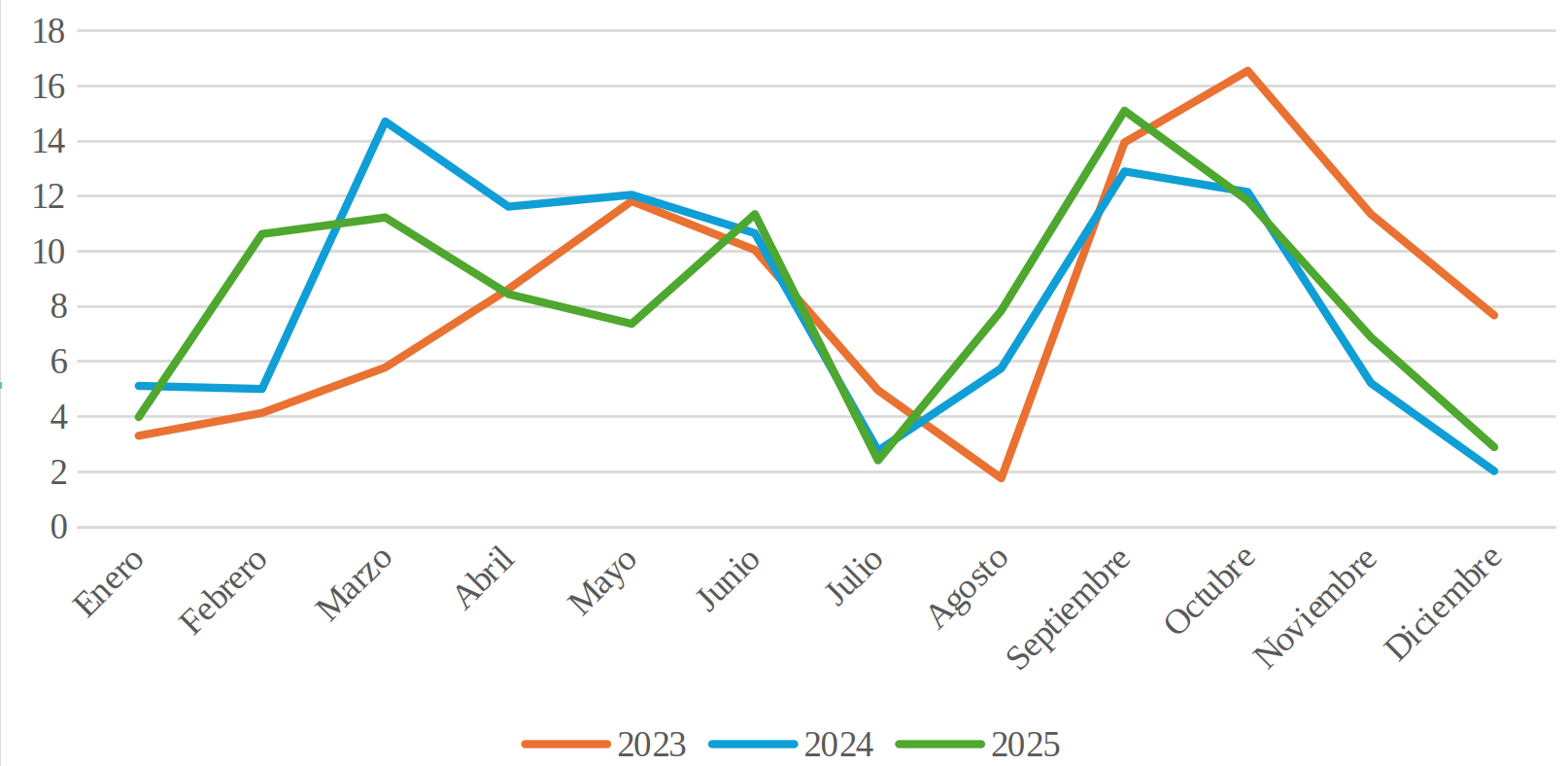
Taken together, the results demonstrate that psychological service demand exhibits predictable and recurring fluctuations, with peaks concentrated during critical academic periods and marked reductions during recesses. This temporal regularity provides empirical evidence useful for preventive planning in university mental health services, enabling institutions to anticipate surges in demand and optimise staffing allocation and intervention strategies during months of heightened psychoemotional risk.
Discussion
This study aimed to examine the longitudinal demand for psychological care among university students across 2023, 2024, and 2025 to identify temporal patterns relevant to preventive planning in mental health. The findings show consistent monthly fluctuations in demand, characterised by recurring increases in the months preceding final examinations and marked declines during academic recesses. This pattern supports the view that the academic calendar constitutes a primary organising factor of psychological service demand within higher education.
The demand peaks observed during periods of elevated academic workload align with previous research documenting significant increases in stress, anxiety, and depressive symptoms among university students during assessment and end-of-semester periods (Beiter et al., 2015; Pascoe et al., 2020; Saleh et al., 2017; Stallman, 2010). These findings suggest that academic pressure functions as a salient contextual stressor that elevates the need for formal psychological support and the utilisation of university counselling services.
Furthermore, the stability of this temporal pattern across the three years analysed indicates that service demand does not reflect isolated events, but rather a relatively predictable structural dynamic tied to the academic cycle. Studies conducted in university counselling centres have reported similar findings, showing cyclical surges in mental health service utilisation at specific points in the year, which can lead to service overload without adequate advance planning (Gallagher, 2015; LeViness et al., 2019; Watkins et al., 2012; Xiao et al., 2017).
Conversely, academic recess months, such as August and December, consistently showed the lowest demand for psychological care. This decrease aligns with research demonstrating reductions in academic stress and psychological distress when academic demands subside (Bayram & Bilgel, 2008; Bewick et al., 2010). Nevertheless, these periods also present a strategic opportunity to implement preventive interventions, psychoeducational programmes, and well-being initiatives aimed at strengthening personal resources before periods of heightened demand commence.
From a mental health management and prevention perspective, the findings offer relevant implications for organising university psychological services. Identifying critical months allows institutions to anticipate demand surges and design targeted strategies, such as temporary staffing reinforcement, brief group interventions, and academic stress management programmes. These measures align with international recommendations to strengthen early detection and prevention of psychological distress in university populations (Drum et al., 2009; Prince, 2015; World Health Organization [WHO], 2022).
Finally, these results should be interpreted in light of several limitations. The use of aggregated administrative records precludes the analysis of individual variables such as sex, age, degree programme, or presenting problem, and prevents causal inferences between academic workload and psychological care demand. Future studies should incorporate inferential analyses and individual-level variables to elucidate the mechanisms underlying these fluctuations and strengthen evidence for institutional decision-making (Eisenberg et al., 2013; Pedrelli et al., 2015).
Overall, these findings provide robust empirical evidence of predictable temporal patterns in university students' psychological service demand, highlighting the value of integrating longitudinal analyses into preventive planning and the strategic management of university mental health services.
Conclusions
This study identified consistent temporal patterns in university students' psychological care demand across 2023, 2024, and 2025, demonstrating that consultation requests are not distributed evenly throughout the academic year. The findings show that months preceding final examinations account for the highest demand levels, whereas academic recess months exhibit substantial decreases in service requests.
These results reinforce the importance of treating the academic calendar as a critical determinant in planning university mental health services, rather than merely an administrative framework. The regular occurrence of demand peaks suggests that periods of heightened psychoemotional vulnerability can be anticipated, enabling the implementation of preventive and early intervention strategies tailored to specific times of the year.
From an applied perspective, the findings offer empirical evidence to optimise staffing and organisational resources within university psychological services. Identifying high-demand months can guide measures such as temporary staff reinforcements, brief group interventions, academic stress management programmes, and targeted psychoeducational initiatives, fostering more timely and effective care.
In terms of public health and prevention, longitudinal analysis of service demand provides a valuable tool for strategic well-being management by supporting data-driven, contextualised decision-making. Incorporating such analyses into institutional policies can enhance preventive frameworks and cultivate an institutional culture centred on mental health care.
Finally, the results highlight the need for continued longitudinal, prevention-oriented research on psychological care demand in higher education, integrating individual and academic variables to deepen understanding of factors linked to student distress. Such insights will support the development of university mental health services that are more responsive, efficient, and attuned to student needs.
References
American College Health Association. (2019). American College Health Association-National College Health Assessment II: Reference group executive summary, Spring 2019. American College Health Association.
American College Health Association. (2022). American College Health Association-National College Health Assessment III: Undergraduate student reference group executive summary, Spring 2022. American College Health Association.
Auerbach, R. P., Mortier, P., Bruffaerts, R., Alonso, J., Benjet, C., Cuijpers, P., Demyttenaere, K., Ebert, D. D., Green, J. G., Hasking, P., Murray, E., Nock, M. K., Pinder-Amaker, S., Sampson, N. A., Stein, D. J., Vilagut, G., Zaslavsky, A. M., & Kessler, R. C. (2018). WHO World Mental Health Surveys International College Student Project: Prevalence and distribution of mental disorders. Journal of Abnormal Psychology, 127(7), 623–638. https://doi.org/10.1037/abn0000362
Bayram, N., & Bilgel, N. (2008). The prevalence and socio-demographic correlations of depression, anxiety and stress among a group of university students. Social Psychiatry and Psychiatric Epidemiology, 43, 667–672. https://doi.org/10.1007/s00127-008-0345-x
Beiter, R., Nash, R., McCrady, M., Rhoades, D., Linscomb, M., Claraham, M., & Sammut, S. (2015). The prevalence and correlates of depression, anxiety, and stress in a sample of college students. Journal of Affective Disorders, 173, 90–96. https://doi.org/10.1016/j.jad.2014.10.054
Bewick, B., Koutsopoulou, G., Miles, J., Slaa, E., & Barkham, M. (2010). Changes in undergraduate students’ psychological well‐being as they progress through university. Studies in Higher Education, 35(6), 633–645. https://doi.org/10.1080/03075070903216643
Blanco, C., Okuda, M., Wright, C., Hasin, D. S., Grant, B. F., Liu, S.-M., & Olfson, M. (2008). Mental health of college students and their non–college-attending peers. Archives of General Psychiatry, 65(12), 1429–1437. https://doi.org/10.1001/archpsyc.65.12.1429
Drum, D. J., Brownson, C., Denmark, A. B., & Smith, S. E. (2009). New data on the nature of suicidal crises in college students: Shifting the paradigm. Professional Psychology: Research and Practice, 40(3), 213–222. https://doi.org/10.1037/a0014465
Duffy, A., Saunders, K. E. A., Malhi, G. S., Patten, S., Cipriani, A., McNevin, S. H., MacDonald, E., & Geddes, J. (2019). Mental health care for university students: A way forward? The Lancet Psychiatry, 6(11), 885–887. https://doi.org/10.1016/S2215-0366(19)30275-5
Eisenberg, D., Hunt, J., & Speer, N. (2013). Mental health in American colleges. Journal of Nervous and Mental Disease, 201(1), 60–67. https://doi.org/10.1097/NMD.0b013e31827ab077
Gallagher, R. P. (2015). National survey of college counseling centers 2014 (Monograph Series No. 9V). International Association of Counseling Services.
Hunt, J., & Eisenberg, D. (2010). Mental Health Problems and Help-Seeking Behavior Among College Students. Journal of Adolescent Health, 46(1), 3–10. https://doi.org/10.1016/j.jadohealth.2009.08.008
Ibrahim, A. K., Kelly, S. J., Adams, C. E., & Glazebrook, C. (2013). A systematic review of studies of depression prevalence in university students. Journal of Psychiatric Research, 47(3), 391–400. https://doi.org/10.1016/j.jpsychires.2012.11.015
Kessler, R. C., Berglund, P., Demler, O., Jin, R., Merikangas, K. R., & Walters, E. E. (2005). Lifetime prevalence and age-of-onset distributions of DSM-IV disorders in the National Comorbidity Survey Replication. Archives of General Psychiatry, 62(6), 593–602. https://doi.org/10.1001/archpsyc.62.6.593
LeViness, P., Gorman, K., Braun, L., Koenig, L., & Bershad, C. (2019). The Association for University and College Counseling Center Directors annual survey: 2019. Association for University and College Counseling Center Directors.
Lipson, S. K., Lattie, E. G., & Eisenberg, D. (2019). Increased rates of mental health service utilization by U.S. college students: 10-year population-level trends (2007–2017). Psychiatric Services, 70(1), 60–63. https://doi.org/10.1176/appi.ps.201800332
Pascoe, M. C., Hetrick, S. E., & Parker, A. G. (2020). The impact of stress on students in secondary school and higher education. International Journal of Adolescence and Youth, 25(1), 104–112. https://doi.org/10.1080/02673843.2019.1596823
Pedrelli, P., Nyer, M., Yeung, A., Zulauf, C., & Wilens, T. (2015). College students: Mental health problems and treatment considerations. Academic Psychiatry, 39(5), 503–511. https://doi.org/10.1007/s40596-014-0205-9
Prince, J. P. (2015). University student counseling and mental health in the United States: Trends and challenges. Mental Health & Prevention, 3(1–2), 5–10. https://doi.org/10.1016/j.mhp.2015.03.001
Saleh, D., Camart, N., & Romo, L. (2017). Predictors of stress in college students. Frontiers in Psychology, 8, 19. https://doi.org/10.3389/fpsyg.2017.00019
Sharp, J., & Theiler, S. (2018). A review of psychological distress among university students: Pervasiveness, implications and potential points of intervention. International Journal for the Advancement of Counselling, 40(3), 193–212. https://doi.org/10.1007/s10447-018-9321-7
Stallman, H. M. (2010). Psychological distress in university students: A comparison with general population data. Australian Psychologist, 45(4), 249–257. https://doi.org/10.1080/00050067.2010.482109
Watkins, D. C., Hunt, J. B., & Eisenberg, D. (2012). Increased demand for mental health services on college campuses: Perspectives from administrators. Qualitative Social Work, 11(3), 319–337. https://doi.org/10.1177/1473325011401468
World Health Organization. (2022). World mental health report: Transforming mental health for all. https://www.who.int/publications/i/item/9789240049338
Xiao, H., Carney, D. M., Youn, S. J., Janis, R. A., Castonguay, L. G., Hayes, J. A., & Locke, B. D. (2017). Are we in crisis? National mental health and treatment trends in college counseling centers. Psychological Services, 14(4), 407–415. https://doi.org/10.1037/ser0000130